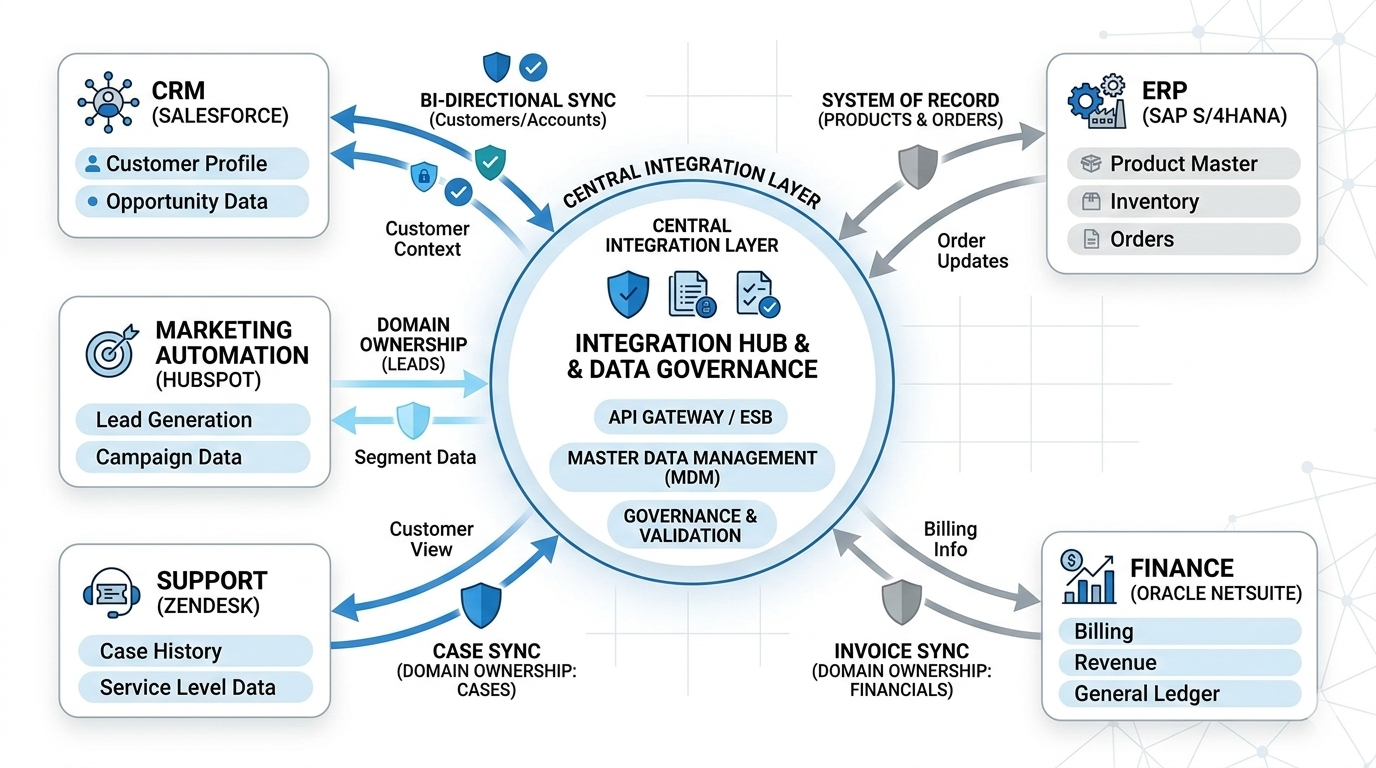
Modern organizations operate in complex digital ecosystems. Customer data flows across CRM platforms, ERP systems, marketing automation tools, finance software, and support applications. Each platform captures valuable information. However, when these systems connect, ownership of that data often becomes unclear. As a result, businesses face duplication, inconsistencies, and reporting conflicts.
Data ownership is not merely a technical setting. Instead, it is a strategic decision that defines authority, accountability, and control. Without defined ownership, integrations create confusion rather than clarity. Therefore, establishing structured data ownership models becomes essential in multi-system environments.
What Is Data Ownership?
Data ownership refers to the authority responsible for defining, maintaining, and approving changes to specific data sets. It differs from data stewardship. Owners make strategic decisions about data. Stewards manage quality and enforcement at an operational level.
Ownership can exist at two levels. First, business ownership determines who defines rules and accountability. Second, technical ownership determines which system has authority to create or update records. In integrated environments, both levels must align. Otherwise, systems compete for control.
Consider a CRM connected to a project management platform through an Airtable Salesforce Integration. When customer data synchronizes between these systems, clarity about which platform owns specific fields becomes critical. Without defined ownership, updates may override each other. Consequently, reporting accuracy suffers, and user trust declines.
Why Data Ownership Becomes Complex in Multi-System Integrations
Data ownership becomes complicated when multiple systems manage overlapping objects. For example, both CRM and ERP systems may store account details. Marketing automation platforms may also hold contact data. Therefore, the same entity exists in multiple locations.
Bi-directional synchronization increases this complexity. When systems update each other, conflicts emerge. Real-time integrations intensify the risk. A change in one platform may overwrite validated information in another.
Additionally, mergers and acquisitions often introduce new tools into the ecosystem. Legacy systems remain active for operational reasons. As a result, organizations must manage layered architectures with unclear authority lines.
Moreover, modern integration patterns emphasize automation. Event-driven architectures propagate changes instantly. While this improves speed, it also amplifies ownership conflicts. Thus, clarity must precede connectivity.
Common Data Ownership Models
Different organizations adopt different ownership models. Each model reflects operational maturity and architectural complexity.
System of Record (Single Source of Truth)
In this model, one system serves as the authoritative source for specific data. Other systems consume that data without modifying it. For example, ERP may own financial data. CRM may own opportunity data.
This approach reduces conflicts significantly. However, it requires strong governance. All stakeholders must agree on system boundaries. Furthermore, integration logic must enforce read-only rules where necessary.
Functional Ownership Model
Functional ownership assigns data responsibility based on departments. Sales may own accounts and opportunities. Finance may own billing information. Marketing may own campaign data.
This model aligns with business accountability. However, it requires cross-functional coordination. Otherwise, departmental silos create friction. Therefore, governance forums become essential.
Domain-Based Ownership
Domain-based ownership organizes data into domains such as Customer, Product, or Financial. Each domain has defined owners and policies. This model aligns well with enterprise data governance frameworks.
For example, the Customer domain may include accounts, contacts, and related attributes. Ownership remains consistent across systems. Consequently, integration logic becomes clearer and easier to maintain.
Federated Ownership Model
In federated models, multiple systems share responsibility under structured rules. Validation logic determines which updates prevail. This model works in complex ecosystems where strict centralization is impractical.
However, federated models require advanced monitoring and governance. Otherwise, ownership ambiguity resurfaces.
Ownership by Data Object
Ownership should also be defined at the object level. Not all data behaves the same way.
Accounts may originate in CRM. However, ERP may enrich them with billing details. Contacts may sync from marketing tools but require validation in CRM. Opportunities typically belong to Sales systems. Orders and invoices often belong to ERP.
Additionally, ownership may change across lifecycle stages. For example, a lead originates in marketing. Once qualified, CRM may assume authority. After conversion into a customer, ERP may manage financial attributes.
Therefore, ownership must reflect business processes, not just system capabilities.
Integration Patterns and Their Impact on Ownership
Integration architecture directly influences ownership clarity.
One-way synchronization supports strong system-of-record models. In this pattern, updates flow from master to secondary systems. Consequently, ownership remains clear.
Bi-directional synchronization, however, introduces complexity. Both systems can update records. Therefore, rules must determine precedence. Without such rules, last-write-wins logic may override validated data.
Event-driven architectures add another dimension. Changes trigger automated workflows across systems. Although efficient, these architectures demand precise field-level ownership rules.
Middleware platforms often help manage ownership logic centrally. They can enforce validation, transformation, and conflict resolution rules. However, governance must still define authority boundaries.
Governance Framework for Clear Ownership
Clear ownership requires structured governance. A RACI matrix helps define roles. It identifies who is Responsible, Accountable, Consulted, and Informed for each data domain.
Field-level ownership rules should be documented. For example, CRM may own email fields. ERP may own payment terms. These definitions prevent integration conflicts.
Additionally, change management processes must exist. When new fields or systems are introduced, ownership definitions must update accordingly. Otherwise, undocumented changes create silent conflicts.
Data validation and enforcement controls also play a role. Required fields, format checks, and approval workflows maintain quality. However, they must align with ownership boundaries.
Conflict Resolution Mechanisms
Even with defined ownership, conflicts may occur. Therefore, organizations must implement resolution mechanisms.
Last-write-wins logic is simple but risky. It may overwrite verified data. Timestamp-based overrides provide slightly more control. However, they still ignore business context.
Master priority logic offers a better solution. It defines precedence rules based on source systems. Role-based edit permissions also prevent unauthorized updates.
Furthermore, audit logging ensures traceability. When changes occur, teams can identify sources and reasons. This transparency builds trust in integrated systems.
Risks of Poorly Defined Ownership
Unclear ownership leads to serious consequences. Duplicate records emerge quickly. Reporting discrepancies confuse leadership teams. Revenue forecasting becomes unreliable.
Moreover, compliance risks increase. In regulated industries, incorrect data may lead to penalties. Data privacy regulations require clear accountability. Without defined ownership, accountability weakens.
User trust also declines. When users encounter inconsistent information, they question system reliability. Eventually, manual workarounds appear. Spreadsheets replace integrated workflows. Consequently, integration investments lose value.
Operational inefficiencies multiply as well. Teams spend time reconciling data instead of analyzing insights. Therefore, ownership clarity protects both strategic and operational performance.
Designing a Sustainable Data Ownership Strategy
Designing a sustainable strategy requires a business-first mindset. Organizations should map core processes before defining system authority. Lifecycle stages provide guidance for ownership transitions.
Next, integration points must be documented clearly. Each data flow should specify direction, frequency, and ownership rules. Escalation paths must exist for conflict resolution.
Documentation should remain accessible and updated. As systems evolve, ownership definitions must adapt. Governance committees can review changes periodically.
Moreover, alignment with enterprise architecture principles ensures long-term stability. Data domains, integration standards, and security controls must work together. Ownership cannot operate in isolation.
Real-World Scenario Example
Consider an organization using CRM, ERP, and marketing automation platforms. Leads originate in marketing automation. CRM assumes ownership upon qualification. ERP then manages billing data after customer conversion.
In this scenario, clear ownership prevents conflicts. Marketing does not overwrite CRM opportunity data. ERP does not modify pipeline forecasts. Each system performs its defined role.
Middleware enforces validation rules. Audit logs capture all changes. Governance committees review new integration requests. As a result, the organization maintains data consistency across platforms.
Conclusion
Data ownership models form the backbone of successful multi-system integrations. Without clear authority definitions, integrations amplify chaos. However, structured ownership frameworks create stability and trust.
Organizations must align business processes with system authority. They must define object-level ownership and enforce field-level rules. Additionally, governance frameworks must support ongoing adaptation.
Ultimately, integration success depends on clarity, not connectivity alone. When ownership is defined strategically, systems collaborate effectively. Consequently, businesses gain accurate insights, operational efficiency, and scalable growth
Author

john@gmail.com
Related Posts

Criminal Court Process Pakistan: A Complete Guide from FIR to Final Verdict
Pakistan’s criminal justice system is designed to ensure fairness, accountability, and adherence to the rule of law. That is why understanding the...
Read out all
What Personal Data Should I Avoid Storing on an NFC Business Card?
Picture this: You’re at a networking event, confidently tapping your sleek NFC business card against someone’s phone. In seconds, your information transfers...
Read out allExperience Dubai in Style: Rent a Luxury Audi in Dubai
Dubai is a city where luxury meets innovation. From iconic skyscrapers to stunning beaches and world-class entertainment, the city offers experiences that...
Read out allInsurance Confusion During Vehicle Shifting – What You Must Check
Vehicle shifting insurance baffles many in Nagpur, leading to denied claims and shock bills. Comprehensive motor policies don’t cover transit—enter car shifting service...
Read out all
Plumbers Near Me: Trusted Local Experts for Fast Repairs
Finding a trustworthy plumber near me saves time, money, and stress when a leak or clog disrupts your day. Look for licensed local...
Read out all
Residential Snow Removal Near Me: Trusted Local Service for Home Driveways
When snow threatens your driveway and walkways, you want a fast, reliable solution you can hire today. You can find local residential snow...
Read out all